Artificial Intelligence is rapidly transforming the way organizations operate. From predictive analytics to intelligent automation, businesses are increasingly adopting AI to streamline operations, enhance decision-making, and create new competitive advantages.
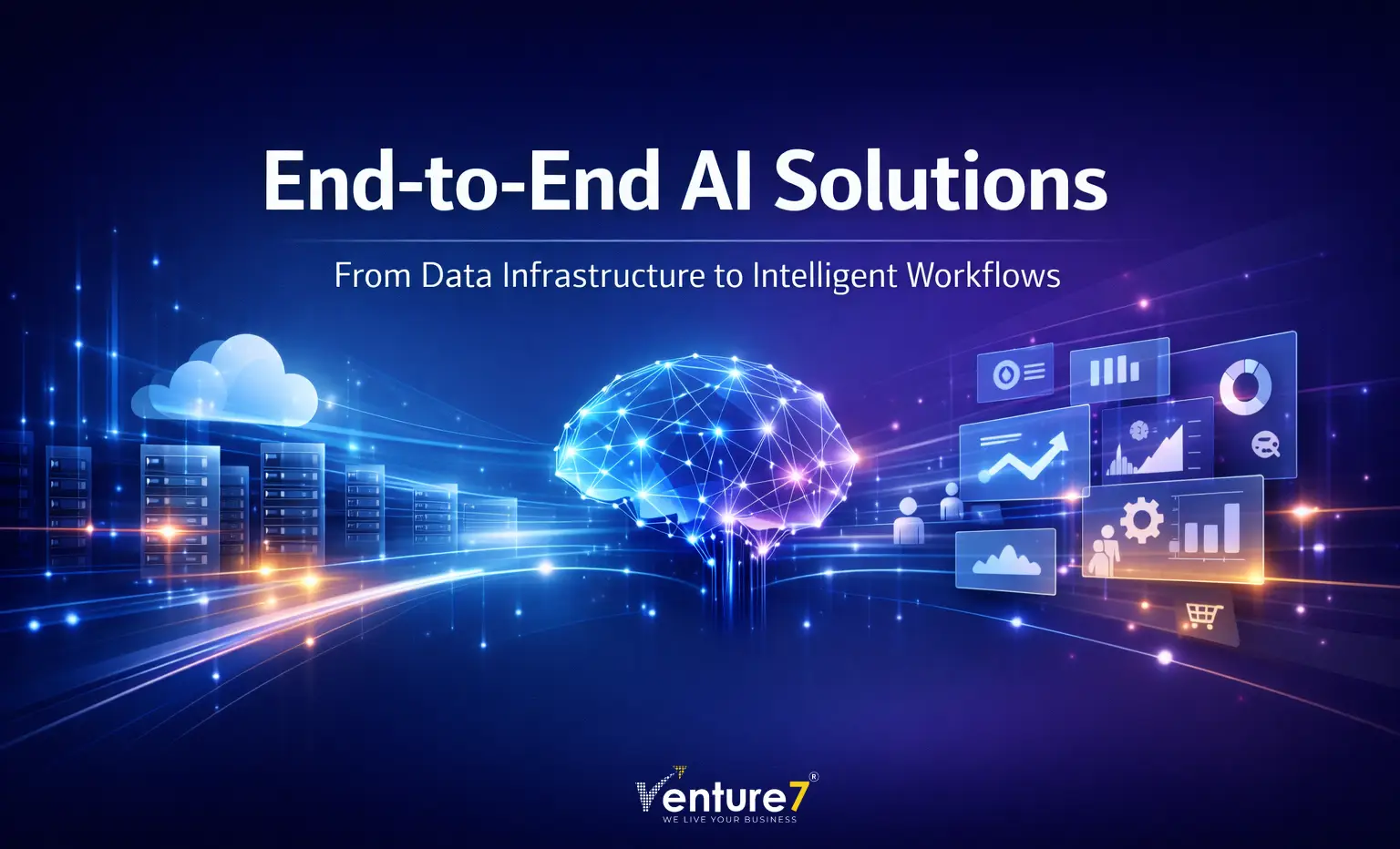
However, many companies struggle to scale AI beyond isolated experiments. The real power of artificial intelligence is unlocked when organizations implement end-to-end AI solutions that connect data infrastructure, AI models, and intelligent workflows into a unified ecosystem.
Venture7® builds end-to-end AI development solutions that help organizations transform raw data into automated intelligent workflows, enabling businesses to operate faster, smarter, and more efficiently.
This guide explores how end-to-end AI systems work, why they are essential for modern enterprises, and how businesses can implement AI-powered workflows at scale.
What Are End-to-End AI Solutions?
End-to-end AI solutions are integrated systems that connect data infrastructure, artificial intelligence models, and automated workflows to transform raw data into actionable insights and intelligent business operations.
Instead of deploying standalone AI tools, organizations implement complete AI ecosystems that collect data, generate insights, and automatically execute decisions.
Venture7® develops enterprise end-to-end AI solutions that integrate data engineering, machine learning models, generative AI technologies, and workflow automation platforms to create scalable AI-driven business systems.
Why End-to-End AI Solutions Matter for Businesses
Many organizations invest in artificial intelligence but fail to generate measurable business outcomes because AI systems are disconnected from operational workflows.
Common challenges include:
- fragmented data across multiple systems
- AI models that remain in experimental stages
- lack of integration with enterprise software
- manual processes that slow down decision-making
End-to-end AI solutions address these problems by creating a connected architecture that links data, intelligence, and automation.
Venture7® helps businesses implement AI ecosystems where data flows seamlessly from infrastructure to intelligent workflows that automate operations and support strategic decision-making.
Key Benefits of End-to-End AI Solutions
Unified Data Intelligence
Artificial intelligence systems rely on high-quality data.
End-to-end AI solutions integrate data from multiple business platforms, including:
- CRM systems
- ERP platforms
- marketing automation tools
- customer support platforms
- analytics systems
This unified data layer enables organizations to generate insights from a single source of truth.
Venture7® designs enterprise data infrastructures that power advanced AI analytics and machine learning applications.
Intelligent Decision-Making
AI models can analyze massive datasets to identify patterns and trends that humans may overlook.
These insights enable businesses to make faster and more accurate decisions.
Examples include:
- demand forecasting
- customer behavior prediction
- fraud detection
- predictive maintenance
Venture7® develops machine learning models that enable organizations to use predictive intelligence for strategic and operational decisions.
Intelligent Workflow Automation
AI becomes truly powerful when it is embedded within operational workflows.
Intelligent workflows automate repetitive tasks and improve operational efficiency.
Examples include:
- automated lead scoring and sales engagement
- AI-powered customer support chatbots
- intelligent document processing
- marketing campaign optimization
Venture7® builds intelligent automation systems that transform AI insights into real-time business actions.
Scalable AI Infrastructure
End-to-end AI solutions provide scalable infrastructure that allows organizations to deploy AI across departments.
Scalable AI architectures support:
- real-time data processing
- machine learning pipelines
- cloud-based integrations
- enterprise automation frameworks
Venture7® develops scalable AI infrastructures that allow businesses to expand AI capabilities as their operations grow.
The Architecture of End-to-End AI Systems
Successful AI ecosystems typically consist of several interconnected layers.
Understanding these layers helps organizations implement scalable AI solutions.
1. Data Infrastructure Layer
Data infrastructure is the foundation of artificial intelligence systems.
This layer collects, processes, and stores data from multiple sources.
Key components include:
- data lakes
- data warehouses
- data pipelines
- data governance frameworks
These systems ensure that AI models have access to reliable and structured data.
Venture7® builds modern data infrastructures that enable organizations to implement advanced AI and analytics capabilities.
2. AI Model Development
Once data infrastructure is established, organizations can develop AI models that analyze and interpret data.
Common AI model types include:
Predictive AI
Predictive models analyze historical data to forecast future outcomes such as demand trends or customer behavior.
Generative AI
Generative AI systems can create content, automate tasks, and power AI assistants.
Machine Learning Systems
Machine learning algorithms identify patterns and improve performance through continuous learning.
Natural Language Processing
NLP technologies power chatbots, document analysis systems, and semantic search engines.
Venture7® develops custom AI models designed to solve complex business challenges across industries.
3. AI Deployment and Integration
Many organizations develop AI models but struggle to deploy them into production environments.
End-to-end AI solutions ensure that models are deployed within operational systems.
Deployment typically involves:
- cloud infrastructure
- APIs and microservices
- MLOps pipelines
- enterprise integrations
These systems allow AI models to interact with business platforms such as CRM, ERP, and analytics systems.
Venture7® specializes in deploying AI models into enterprise technology ecosystems.
4. Intelligent Workflow Automation
The automation layer connects AI insights to business processes.
When AI systems generate predictions or insights, automated workflows execute corresponding actions.
Examples include:
- AI-driven sales automation
- automated marketing campaigns
- intelligent customer service systems
- automated financial analysis
Venture7® designs AI-driven workflow automation platforms that enable organizations to operate with intelligent efficiency.
5. Continuous Learning and Optimization
Artificial intelligence systems must evolve as new data becomes available.
Continuous learning frameworks enable AI models to improve over time.
These systems use feedback loops to retrain models using:
- new operational data
- user interactions
- performance metrics
Venture7® implements AI optimization frameworks that allow enterprise AI systems to continuously improve and adapt.
Real-World Applications of End-to-End AI Solutions
Organizations across industries are adopting AI ecosystems to improve operational efficiency, automate complex processes, and deliver better customer experiences. By combining data infrastructure, machine learning models, and intelligent workflow automation, AI solutions can transform how businesses operate.
Venture7® develops enterprise AI solutions across multiple industries, enabling organizations to deploy intelligent workflows and data-driven decision systems.
Below are key industries where AI is driving measurable transformation.
AI for Healthcare
Healthcare organizations are increasingly adopting AI to improve patient care, streamline operations, and reduce administrative workload. AI-powered systems enable healthcare providers to automate clinical processes while improving diagnostic and operational efficiency.
Key AI applications in healthcare include:
- Clinical documentation automation
- Patient intake and registration automation
- Claims and billing automation
- Care coordination workflows
- Remote patient monitoring systems
- Appointment and referral automation
- Healthcare analytics and reporting
These solutions help healthcare providers improve patient outcomes while optimizing operational efficiency.
AI for Senior Care
Senior care providers are using AI technologies to enhance patient monitoring, improve care coordination, and automate administrative processes.
AI systems support caregivers and healthcare staff by enabling better visibility into patient conditions and operational workflows.
Key AI applications in senior care include:
- Clinical documentation automation
- Patient intake and registration automation
- Claims and billing automation
- Care coordination workflows
- Remote patient monitoring systems
- Appointment and referral automation
- Healthcare analytics and reporting
These technologies allow senior care organizations to deliver better patient care while reducing administrative burden.
AI for Business Processes
Organizations across industries are using AI to automate internal business processes and improve operational efficiency.
AI-powered automation platforms can streamline complex workflows and reduce manual tasks.
Common AI use cases include:
- Process automation
- Workflow orchestration
- Document processing and OCR
- Approval and decision automation
- Data extraction and validation
- Compliance monitoring
- Operational performance analytics
AI-driven process automation enables businesses to scale operations while maintaining accuracy and compliance.
AI for Salesforce
AI technologies integrated with CRM platforms can significantly improve sales productivity and customer insights.
AI-powered CRM systems help organizations automate sales workflows and improve customer engagement.
Key AI use cases for Salesforce include:
- Lead scoring and prioritization
- Sales forecasting
- Customer insights and segmentation
- Workflow automation
- AI-powered service chatbots
- Predictive opportunity management
- Data cleansing and enrichment
These AI solutions help sales teams focus on high-value opportunities and improve conversion rates.
AI for HR and Recruitment
Human resources departments are increasingly adopting AI to improve recruitment efficiency and workforce planning.
AI-powered HR systems help organizations identify the best candidates while optimizing workforce management.
Key AI use cases include:
- Resume screening
- Candidate matching
- Employee attrition prediction
- Workforce planning
- Performance analytics
- HR process automation
- Learning personalization
These technologies allow HR teams to make better hiring decisions and improve employee engagement.
AI for Compliance and Risk Management
Organizations operating in regulated industries must continuously monitor compliance and manage operational risks.
AI solutions can automate compliance monitoring and detect anomalies in real time.
Key AI use cases include:
- Regulatory monitoring
- Policy violation detection
- Audit automation
- Risk scoring
- Reporting automation
- Governance analytics
- Fraud prevention
AI-powered compliance systems reduce risk exposure while improving transparency and regulatory reporting.
AI for SaaS and Enterprise Platforms
SaaS companies and enterprise platforms are using AI to enhance product experiences and improve customer lifecycle management.
AI-driven insights help organizations understand user behavior and optimize product adoption.
Common AI applications include:
- Process automation
- Customer analytics and insights
- Predictive churn analysis
- Product usage analytics
- Workflow orchestration
- AI copilots for teams
- Enterprise reporting and forecasting
These AI capabilities allow organizations to build more intelligent and scalable digital platforms.
AI for EdTech
Education technology platforms are leveraging AI to create personalized learning experiences and improve student outcomes.
AI systems analyze learning behavior and deliver customized educational content.
Key AI applications include:
- Personalized learning experiences
- Student performance prediction
- Automated grading systems
- Virtual AI tutors
- Dropout risk analysis
- Curriculum optimization
- Learning analytics
These technologies enable education platforms to deliver adaptive and data-driven learning environments.
AI for Logistics and Supply Chain
Logistics and supply chain operations generate large amounts of data, making them ideal for AI-driven optimization.
AI systems can analyze supply chain data in real time to improve efficiency and reduce operational costs.
Key AI applications include:
- Demand forecasting
- Inventory optimization
- Route and logistics planning
- Supply chain analytics
- Predictive maintenance for fleets
- Shipment tracking and optimization
- Operational performance analytics
AI-powered logistics systems help organizations reduce costs while improving delivery speed and reliability.
Challenges in Implementing AI Solutions
Despite its benefits, implementing AI at scale presents several challenges.
Common obstacles include:
- fragmented data systems
- lack of AI expertise
- complex integrations with legacy infrastructure
- security and compliance requirements
Organizations addressing these challenges require strong technical architecture and AI development expertise.
Venture7® provides AI consulting, architecture design, and implementation services that help organizations successfully deploy end-to-end AI systems.
The Future of Intelligent Workflows
The future of business automation will be driven by agentic AI systems capable of performing complex tasks autonomously.
These systems will combine:
- generative AI models
- predictive analytics
- automation frameworks
- enterprise integrations
Examples of future AI workflows include:
- AI sales agents managing customer pipelines
- AI marketing assistants optimizing campaigns
- AI operations agents managing logistics
- AI support agents resolving customer requests
Organizations investing in AI infrastructure today will lead the next wave of digital transformation.
Venture7® is actively building AI platforms that enable businesses to deploy intelligent autonomous workflows across their operations.
Conclusion
Artificial intelligence is redefining how modern organizations operate. However, successful AI adoption requires more than deploying isolated tools.
Businesses must implement end-to-end AI solutions that connect data infrastructure, machine learning models, and intelligent workflows into a unified system.
Organizations that invest in these architectures will be able to automate operations, improve decision-making, and unlock new opportunities for innovation.
Venture7® enables organizations to design, build, and scale enterprise-grade end-to-end AI solutions that transform operational data into intelligent business workflows.