
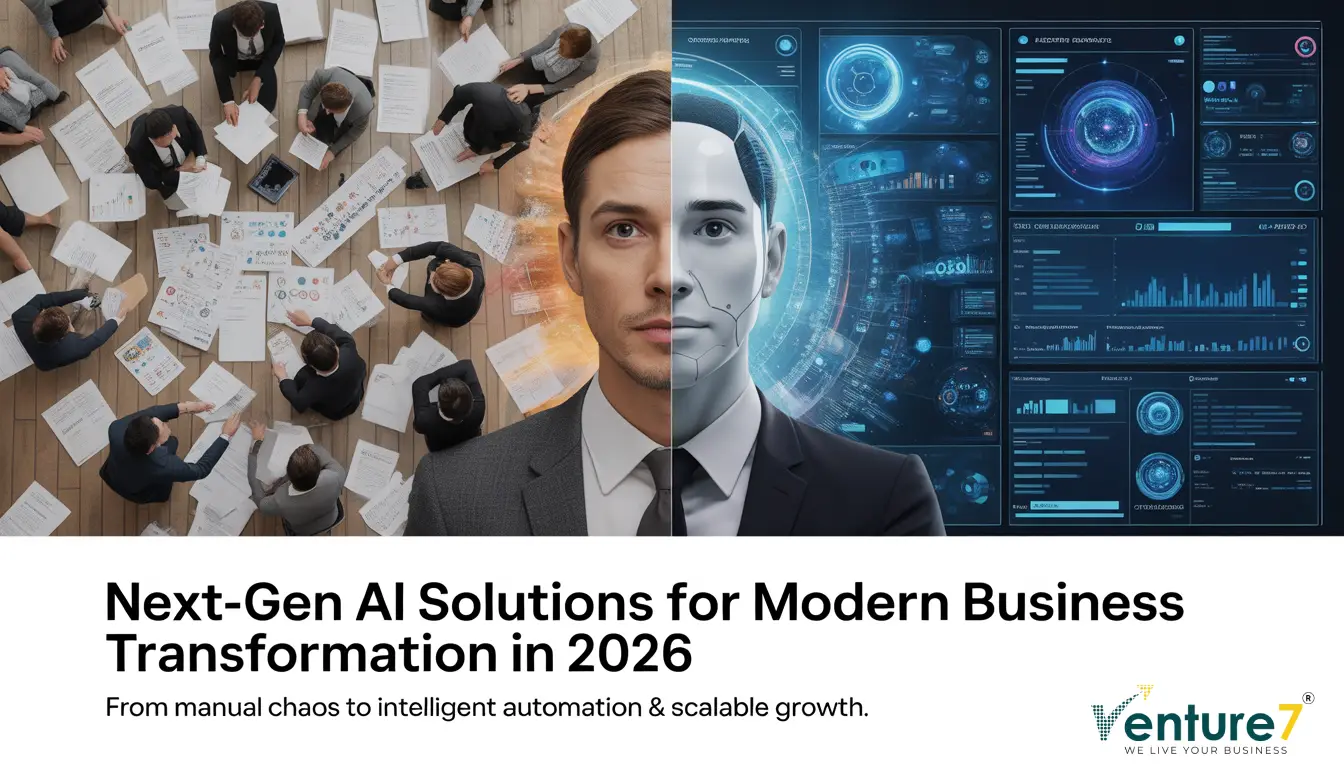
AI solutions for modern business transformation enable organizations to automate operations, enhance decision-making, and scale efficiently using technologies such as AI automation, predictive analytics, and agentic AI. In 2026, businesses adopting next-generation AI systems are achieving 40–60% efficiency gains, faster execution, and sustainable, data-driven growth.
Next-Gen Transformation Insights
- AI transformation is evolving from automation to autonomous, agent-driven systems
- Organizations are achieving 40–60% improvements in operational efficiency
- AI agents are emerging as a scalable digital workforce
- Data-driven decision-making is replacing reactive business models
- AgentOps frameworks are enabling enterprise-scale AI deployment
- AI is becoming foundational to business infrastructure
- Early adopters are gaining measurable competitive advantage
What Are AI Solutions for Modern Business Transformation?
AI solutions for business transformation refer to the integration of advanced technologies such as machine learning, natural language processing, and intelligent automation into core business processes. These solutions enable organizations to improve efficiency, scalability, and decision-making capabilities.
In practical terms, AI allows businesses to replace manual, repetitive tasks with intelligent systems that continuously learn and improve.
Why AI Is Critical for Business Transformation in 2026
Traditional digital transformation strategies are no longer sufficient to address the complexity and scale of modern business environments. Organizations face increasing pressure from rising costs, fragmented data systems, and the need for real-time decision-making.
AI addresses these challenges by enabling:
- Automation of repetitive and time-consuming processes
- Real-time insights from structured and unstructured data
- Reduced dependency on manual intervention
- Scalable operations without proportional increases in cost
Core AI Solutions Driving Business Transformation
AI Process Automation
AI-driven automation extends beyond rule-based systems by incorporating learning capabilities that adapt over time.
Key outcomes:
- Reduction in manual workload by up to 70%
- Improved process accuracy
- Faster operational cycles
Predictive Analytics and Decision Intelligence
Predictive analytics leverages historical and real-time data to forecast outcomes and guide decision-making.
Use cases include:
- Demand forecasting
- Customer behavior analysis
- Risk assessment and mitigation
AI-Powered Customer Experience
AI enhances customer engagement through personalization and responsiveness.
Capabilities include:
- 24/7 customer support through intelligent systems
- Personalized recommendations based on user behavior
- Faster issue resolution
AI in Sales and Marketing Automation
AI optimizes sales and marketing processes through data-driven insights.
Applications include:
- Lead scoring and prioritization
- Campaign optimization
- Customer segmentation
Agentic AI and Autonomous Systems
Agentic AI represents the next stage of AI evolution, where systems operate with a high degree of autonomy.
Definition:
Agentic AI refers to systems capable of independently planning, making decisions, and executing tasks without continuous human input.
AgentOps and AI Agents as a Digital Workforce
AgentOps (AI Agent Operations) provides the infrastructure required to deploy, manage, and scale AI agents across business functions.
Key capabilities
- Autonomous task execution
- Coordination between multiple AI agents
- Continuous learning and optimization
Practical example
An AI agent can manage customer interactions, update internal systems, trigger workflows, and generate reports without human intervention. This reduces operational overhead while improving consistency and speed.
Traditional vs AI-Driven Business Models
| Aspect | Traditional Model | AI-Driven Model |
|---|---|---|
| Operations | Manual and fragmented | Automated and intelligent |
| Decision-making | Reactive | Predictive and real-time |
| Scalability | Limited | Highly scalable |
| Workforce | Human-dependent | AI-human collaboration |
| Efficiency | Moderate | High (40–60% improvement) |
Real-World Applications of AI Transformation
Healthcare
- AI-assisted diagnostics
- Automated patient workflows
- Predictive treatment models
Outcome: Improved patient care and reduced administrative burden
E-commerce
- Personalized product recommendations
- AI-driven customer support
- Inventory and demand prediction
Outcome: Increased conversions and improved customer experience
SaaS
- Predictive churn analysis
- Automated onboarding processes
- AI-powered customer success management
Outcome: Higher retention and reduced churn
Enterprise Operations
- End-to-end workflow automation
- Integrated data systems
- Real-time business intelligence
Outcome: Enhanced efficiency and scalability across departments
ROI of AI Transformation
Organizations implementing AI solutions typically achieve measurable outcomes, including:
- 40–60% improvement in operational efficiency
- 30–50% reduction in operational costs
- 20–30% increase in revenue growth
- Faster time-to-market for products and services
AI Transformation Framework
Step 1: Assess Current Processes
Identify inefficiencies and areas suitable for automation
Step 2: Define Strategic Objectives
Align AI initiatives with business goals and KPIs
Step 3: Select Appropriate AI Solutions
Evaluate tools, platforms, and frameworks based on use cases
Step 4: Implement and Integrate
Deploy AI solutions across systems and workflows
Step 5: Optimize and Scale
Continuously improve performance using data insights and feedback loops
Key Challenges in AI Adoption
- Inconsistent or poor-quality data
- Integration with legacy systems
- Initial investment requirements
- Shortage of skilled AI professionals
These challenges can be mitigated through structured planning and the right implementation approach.
How Venture7® Enables AI-Driven Business Transformation
At Venture7®, we work with organizations to design and implement AI-driven transformation strategies that deliver measurable business outcomes.
Our approach includes:
AI Strategy and Consulting
We define clear, outcome-driven AI roadmaps aligned with business objectives
AI Automation Solutions
We automate business processes using intelligent systems to improve efficiency
AgentOps Implementation
We deploy and manage AI agents as a scalable digital workforce
Custom AI Development
We build tailored solutions to address specific enterprise challenges
Based on our experience at Venture7®, organizations that adopt structured AI strategies achieve faster implementation, improved operational efficiency, and scalable growth without proportional cost increases.
Future Trends in AI-Driven Business Transformation (2026)
- Increased adoption of autonomous AI agents across industries
- Expansion of AgentOps as a standard operational framework
- AI integration into core business infrastructure
- Advanced personalization across customer journeys
- Emergence of fully AI-driven decision ecosystems
Conclusion
AI is no longer an optional capability but a foundational element of modern business strategy. Organizations that adopt next-generation AI solutions are better positioned to improve efficiency, scale operations, and drive long-term growth.
At Venture7®, we help businesses transition to AI-first models through structured strategies, intelligent automation, and scalable AgentOps frameworks.
Book a Free AI Strategy Call with Venture7®
Get a Free AI Audit to identify automation opportunities within your organization.