
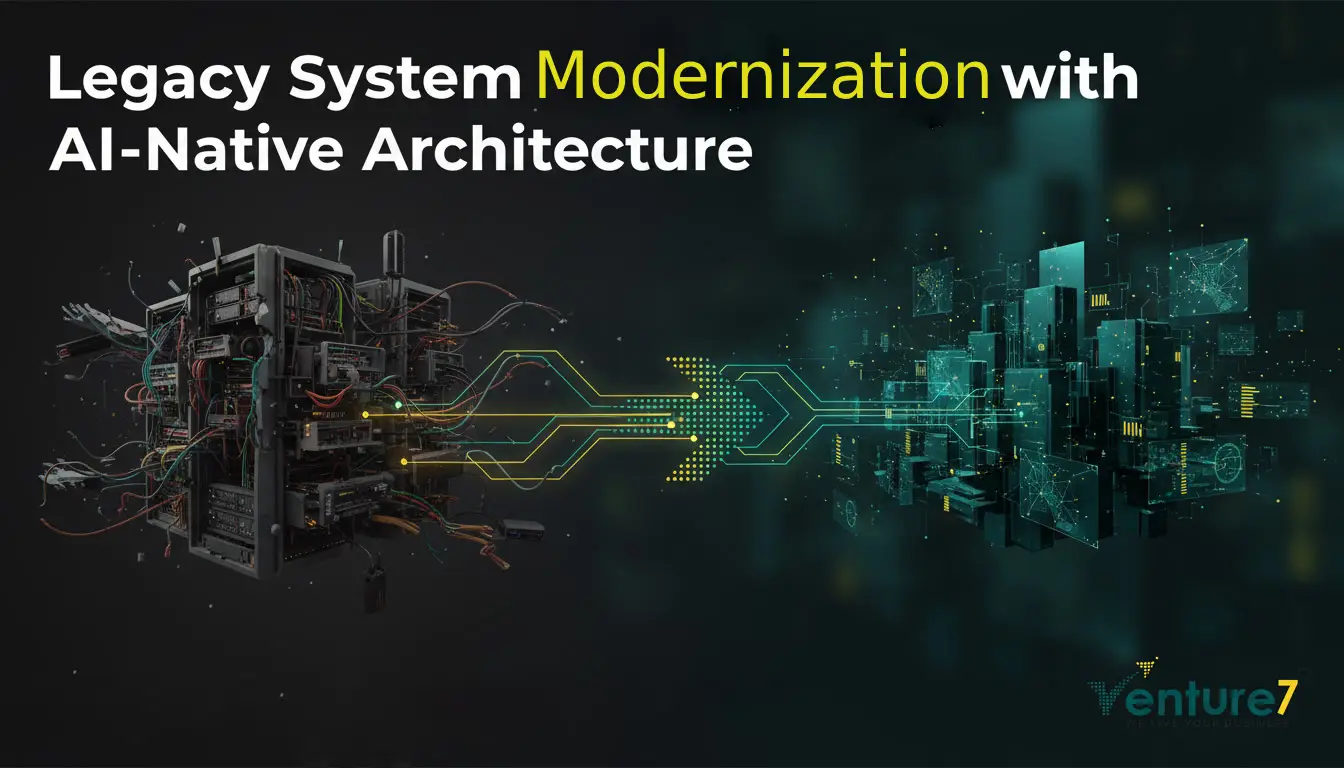
Enterprise systems were originally built for operational stability. Today, they must deliver intelligence, automation, real time decision making, and continuous scalability. Yet many large organizations still rely on monolithic applications, tightly coupled integrations, and siloed data environments that restrict agility and innovation.
Modernization is no longer about upgrading servers or migrating workloads to the cloud. It is about transforming legacy infrastructure into intelligent, adaptive digital platforms.
At Venture7®, modernization is approached through an AI native engineering lens. Intelligence is embedded directly into architecture, workflows, and decision systems from the ground up.
This guide outlines how enterprise leaders can modernize legacy systems using AI native architecture to unlock measurable business value and long term competitive advantage.
The Enterprise Legacy Challenge
Legacy systems remain deeply embedded across enterprise environments. These platforms often include aging CRM systems, ERP environments, custom internal applications, and on premises infrastructure that have evolved over decades.
Common characteristics include:
- Monolithic architecture with limited modularity
- Tight coupling between application layers
- Manual or rule based workflows
- Data silos across departments
- Limited API capabilities
- High maintenance and infrastructure overhead
While these systems may still operate, they frequently limit scalability, delay product innovation, and increase security risk. Technical debt accumulates silently until it begins to affect competitiveness, compliance, and operational efficiency.
Enterprises that delay modernization often experience:
- Slower time to market
- Increased operational cost
- Reduced ability to leverage AI
- Poor data visibility across business units
- Integration bottlenecks that block digital initiatives
Modernization is no longer optional. It is a strategic necessity.
Why Traditional Modernization Approaches Fall Short
Many organizations equate modernization with cloud migration or infrastructure upgrades. While these initiatives can improve performance and cost efficiency, they often fail to deliver transformational impact.
Typical modernization attempts include:
- Lift and shift migration to cloud infrastructure
- User interface redesign without backend transformation
- Partial refactoring without architectural restructuring
These approaches improve hosting environments but preserve outdated business logic, manual processes, and structural limitations.
Without embedding intelligence and automation into the system core, modernization remains incremental rather than strategic.
True modernization requires architectural redesign aligned with intelligent automation.
Defining AI Native Architecture for Enterprises
AI native architecture is an engineering approach where intelligence is embedded across every system layer. AI is not treated as an add on feature. It becomes a foundational design principle.
An AI native enterprise platform includes:
Modular Microservices Architecture
Applications are decomposed into independent services that scale, evolve, and deploy independently. This reduces risk, improves agility, and accelerates release cycles.
API First Integration
Every component communicates through well defined APIs. This enables seamless integration across internal systems, partner platforms, and external services.
Real Time Data Pipelines
Continuous data ingestion, transformation, and enrichment pipelines support real time analytics and decision making.
Embedded AI Decision Engines
Predictive models, machine learning systems, and large language models are integrated into operational workflows. These systems automate decisions and adapt based on new data.
DevSecOps Automation
Continuous integration, testing, deployment, monitoring, and security governance are embedded into the development lifecycle.
AI native systems are designed to learn, adapt, and improve continuously.
Strategic Framework for AI Led Legacy Modernization
Successful enterprise modernization requires a structured and phased approach aligned with business objectives.
Phase 1: Enterprise System Assessment
The journey begins with a comprehensive audit:
- Application portfolio analysis
- Dependency mapping
- Data quality and architecture review
- Security and compliance evaluation
- Workflow bottleneck identification
This phase establishes a clear modernization baseline and identifies high impact transformation opportunities.
Phase 2: AI Native Architecture Blueprint
After assessment, a future state architecture blueprint is designed.
Key components include:
- Microservices decomposition strategy
- Cloud infrastructure planning
- Data lake or lakehouse architecture design
- AI model integration framework
- API gateway and integration strategy
- Security and compliance architecture
This blueprint defines how intelligence, automation, and scalability will be embedded into the enterprise environment.
Phase 3: Incremental Migration Strategy
Replacing legacy systems entirely at once introduces significant operational risk. Instead, enterprises should adopt controlled, incremental migration.
Effective techniques include:
- API wrappers around legacy components
- Parallel system validation
- Feature by feature replacement
- Gradual decommissioning
This approach ensures business continuity while progressively modernizing core capabilities.
Phase 4: Intelligence Embedding
Modernization reaches full impact when intelligence becomes operational.
Enterprises can embed:
- Predictive analytics for demand forecasting
- AI copilots for employee productivity
- Intelligent workflow automation
- Recommendation systems for personalization
- Real time anomaly detection
At this stage, AI is no longer experimental. It becomes integrated into daily enterprise operations.
Phase 5: Continuous Optimization
AI native platforms require ongoing refinement.
Continuous optimization includes:
- Model performance monitoring
- Automated retraining pipelines
- Observability across microservices
- Feedback driven improvements
- Security patch automation
Modernization becomes a continuous capability rather than a one time initiative.
Enterprise Technology Stack Considerations
Technology decisions must align with scalability, governance, and long term flexibility.
Cloud Layer
Hybrid and multi cloud strategies balance performance, resilience, and regulatory requirements.
Data Layer
Centralized data lakes, streaming architectures, and feature stores ensure AI systems receive high quality inputs.
AI Layer
Predictive models, generative AI systems, and intelligent agents enable automation and decision support.
Security Layer
Zero trust architecture, role based access controls, encryption standards, and compliance automation protect enterprise assets.
Architectural decisions should prioritize resilience, scalability, and governance from the outset.
Cost Drivers and ROI Potential
Modernization investments vary based on system complexity, integration depth, and regulatory constraints.
Primary cost drivers include:
- Infrastructure transformation
- Application re architecture
- Data migration and enrichment
- AI model development and integration
- Security and compliance implementation
- Organizational change management
However, AI native modernization generates measurable returns through:
- Reduced infrastructure maintenance cost
- Automation driven operational savings
- Faster product development cycles
- Improved customer personalization
- Enhanced strategic decision making
- Revenue growth enabled by intelligent systems
Enterprises that integrate AI within modernization efforts typically achieve stronger long term ROI compared to infrastructure only upgrades.
Enterprise Use Cases
AI native modernization applies across industries and enterprise functions.
Intelligent CRM Modernization
Embedding AI into CRM platforms enables predictive lead scoring, churn forecasting, and automated engagement strategies.
ERP Workflow Automation
AI driven ERP systems optimize procurement forecasting, inventory planning, and financial anomaly detection.
Commerce Platform Transformation
AI native commerce platforms support real time personalization, intelligent search, dynamic pricing, and automated marketing workflows.
In each case, intelligence becomes embedded into operational workflows rather than layered on top.
Governance, Risk, and Compliance
Enterprise modernization must address governance from the beginning.
Key considerations include:
- Model transparency and explainability
- Bias detection and mitigation
- Data lineage tracking
- Role based access governance
- Compliance alignment with SOC 2, HIPAA, and other regulatory standards
AI native systems must be secure by design and compliant by architecture.
Competitive Advantage Through AI Native Modernization
Organizations that modernize using AI native principles gain strategic advantages:
- Accelerated innovation cycles
- Increased operational efficiency
- Enhanced employee productivity
- Improved customer experience
- Real time strategic insights
- Infrastructure prepared for future technologies
Modernization shifts from maintenance to differentiation.
Why Enterprises Choose Venture7®
Venture7® operates at the intersection of product strategy, data intelligence, and secure cloud engineering.
Our teams deliver:
- AI native system design
- Cloud first, security aware engineering
- Integrated DevSecOps practices
- Scalable microservices architecture
- Embedded AI decision systems
- Continuous delivery pipelines
We do not retrofit intelligence into outdated systems. We architect platforms that are intelligent by design and engineered for scale.
Enterprise Modernization Readiness Assessment
Enterprise leaders should evaluate the following:
- Is your architecture modular and API driven?
- Can AI integrate directly into operational workflows?
- Is your data centralized and analytics ready?
- Do you operate continuous deployment pipelines?
- Are security and compliance processes automated?
If several answers are negative, your organization may benefit from an AI native modernization strategy.
Conclusion
Legacy systems once powered enterprise growth. Today, they often limit it.
AI native modernization enables enterprises to transform static infrastructure into intelligent, adaptive digital platforms designed for scalability, automation, and sustained competitive advantage.
Enterprises ready to modernize should begin with a structured system audit, architectural blueprint, and ROI evaluation aligned with long term business strategy.
Venture7® AI Development Services partners with forward-thinking enterprises to architect and scale intelligent, secure, and future ready digital platforms that drive measurable business growth.