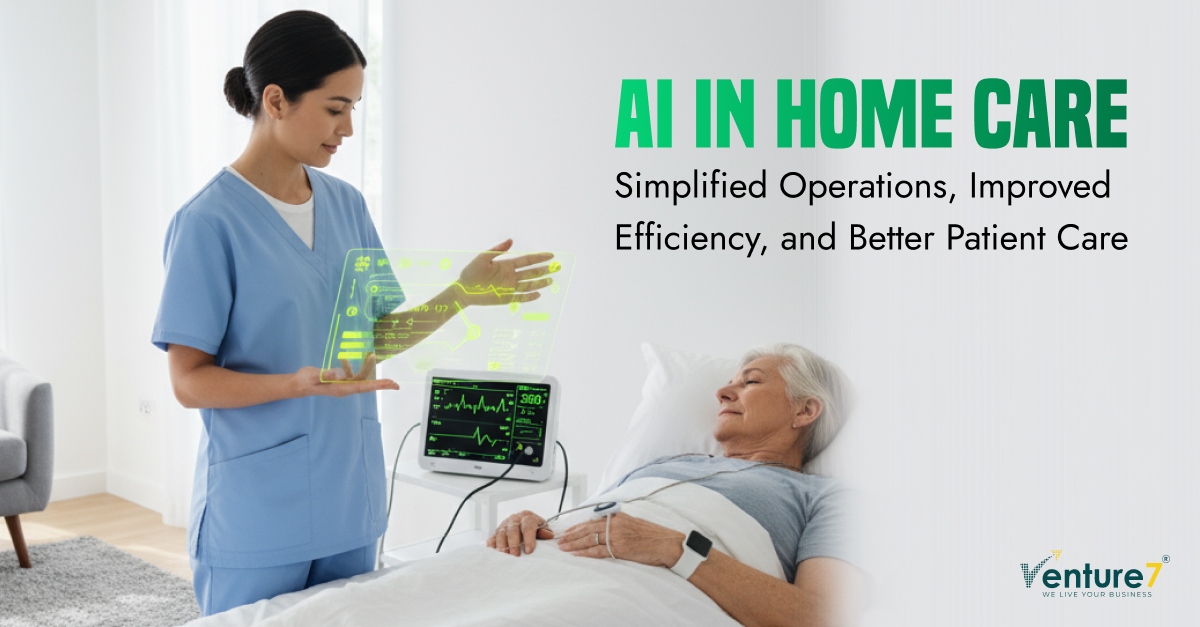
AI in Home Care: Simplified Operations, Improved Efficiency, and Better Patient Care
The U.S. home healthcare sector is at an inflection point. As the aging population grows and the demand for personalized, in-home medical care surges, agencies are struggling to manage staffing shortages, complex scheduling, regulatory compliance, and rising costs. From optimizing caregiver scheduling to predicting patient needs, AI is not just transforming home care operations—it’s redefining what quality care means. For healthcare leaders, now is the time to explore how AI can deliver scalable impact across business and clinical outcomes. AI in home care refers to the application of technologies like machine learning (ML), natural language processing (NLP), computer vision, and generative AI to streamline workflows, improve care coordination, and enhance patient experiences. Automation, on the other hand, replaces repetitive manual tasks—like appointment scheduling, documentation, or billing—with intelligent systems that run autonomously or semi-autonomously. In simple terms: These technologies combine to build AI-powered home care ecosystems, where data drives real-time decision-making, predictive insights, and personalized care delivery. AI presents the only scalable solution to meet this growing demand—enhancing efficiency while maintaining human-centered care. Result: AI reduces human errors, cuts costs, and allows caregivers to focus on what truly matters—caring for patients. Even as home healthcare grows, agencies face persistent operational and business challenges: AI addresses each of these head-on through automation, predictive insights, and smart integrations. AI and automation impact nearly every step of the home care process—from patient intake to caregiver evaluation. AI analyzes real-time traffic, caregiver proximity, skill set, and patient acuity to create optimal schedules—reducing travel time and ensuring better coverage. AI-powered video consultations, chatbots, and predictive health models ensure patients receive timely assistance—especially for chronic or post-surgery monitoring. Integrating IoT sensors and wearable data, AI models detect anomalies such as heart rate spikes or unusual activity patterns—alerting caregivers before a crisis occurs. Using NLP and speech recognition, caregivers can dictate notes or rely on AI-generated care reports—reducing paperwork time by up to 60%. AI validates visit times through Electronic Visit Verification (EVV), flags discrepancies, and ensures billing integrity—saving thousands in potential penalties. AI dashboards provide real-time KPIs, tracking caregiver efficiency, punctuality, and satisfaction levels for continuous improvement. The true value of AI lies in measurable impact—both operationally and clinically. McKinsey reports that healthcare providers using AI and automation see 20–30% cost reductions while improving care quality—proving AI is not just a tech upgrade, but a business growth enabler. Transitioning to AI doesn’t require a full system overhaul. Start with a step-by-step adoption plan: Map repetitive, error-prone, or time-consuming processes—these are your automation targets. Select a partner experienced in healthcare AI, data security, and compliance (HIPAA, HL7, FHIR). Begin with one department (e.g., scheduling or billing), then measure impact before scaling. Gradually expand AI integration into patient monitoring, communication, and analytics. Empower caregivers and admins with AI literacy to ensure smooth adoption. At Venture7®, we help home care agencies across the U.S. build scalable, AI-driven operations through our AI and Automation Cloud Platform. Our solution combines: 40% faster caregiver scheduling Whether you’re looking to automate workflows, improve caregiver efficiency, or deliver better patient outcomes, Venture7® helps you adopt AI without complexity. AI and automation are no longer optional for home healthcare—they’re the foundation of sustainable growth and quality care delivery. The question isn’t whether to adopt AI—it’s how fast you can leverage it to stay competitive. By embracing intelligent automation now, your agency can simplify operations, empower caregivers, and deliver the personalized, proactive care every patient deserves. Venture7® stands ready to help you make that transformation—turning your data into decisions and your workflows into smart, scalable systems. How is AI used in home healthcare today? Is AI safe and compliant for healthcare use? How does AI improve caregiver efficiency? What ROI can home healthcare agencies expect from AI adoption? 5. Can small and mid-sized home care agencies afford AI solutions?
Artificial Intelligence (AI) and automation are reshaping this landscape—turning manual, time-consuming processes into intelligent, efficient, and data-driven workflows.What is AI in Home Care?
AI helps decide what needs to be done.
Automation does it—accurately and consistently.Why Home Care Needs AI Now More Than Ever
Manual vs Automated Home Care
Aspect Manual Process AI-Driven Automation Scheduling Manually assigning caregivers, prone to conflicts Intelligent routing based on location, availability, and skill Billing Manual data entry, errors in documentation Automated EHR sync and real-time invoicing Care Documentation Time-consuming note-taking Voice-to-text or AI-generated care summaries Patient Monitoring Reactive—caregiver reports only Predictive—IoT + AI detect anomalies early Compliance Manual audits and record-keeping AI alerts for missing documentation or EVV validation Top 5 Challenges for Home Healthcare Agencies
Application of AI in Home Care Process
1. Smart Scheduling and Route Optimization
2. Virtual Care and Telehealth Enablement
3. Predictive Health Monitoring
4. Automated Documentation
5. Fraud Detection and Compliance Automation
6. Caregiver Performance Analytics
Impact of AI and Automation in Home Care
1. Operational Efficiency
2. Improved Patient Care
3. Data-Driven Decision Making
4. Cost Savings and ROI
Tasks Automated to Save Time and Effort in Home Care
Automation Task AI Application Impact Appointment scheduling Predictive workload balancing 30% fewer cancellations Billing & payroll AI-powered validation 25% faster processing EVV compliance Geo-verification + NLP audit Error-free documentation Care documentation Generative AI summaries Saves 2+ hours daily Communication AI chatbots for patients/families 24/7 engagement Recruitment AI candidate scoring 40% faster hiring cycle Future of Home Healthcare – Trends & Predictions
Autonomous AI agents will handle repetitive queries, onboarding, and care coordination using conversational AI.
Integration of AI, IoT, and EHR systems will enable real-time health predictions—preventing hospital readmissions.
Platforms like Venture7 AI Cloud will forecast demand and auto-adjust staffing levels.
Caregivers will use smart glasses and voice assistants for documentation and real-time patient support.
LLMs like ChatGPT and Perplexity will personalize educational content, reminders, and follow-up communications based on patient profiles.How to Start with AI and Automation in Home Care Operations
Step 1: Assess Current Workflow
Step 2: Choose the Right AI Partner
Step 3: Pilot and Measure
Step 4: Integrate and Scale
Step 5: Upskill the Workforce
Venture7® AI and Automation in Home Care
Key Outcomes for Agencies
35% cost reduction in admin operations
2x improvement in patient satisfaction
Seamless compliance managementConclusion
Frequently Asked Questions (FAQs)
AI is used for caregiver scheduling, predictive health monitoring, automated documentation, and patient communication through AI chatbots and virtual assistants.
Yes. When implemented within HIPAA and FHIR standards, AI ensures data privacy, compliance, and traceability across care workflows.
AI automates administrative tasks, optimizes travel routes, and provides real-time insights—allowing caregivers to spend more time with patients.
Most agencies report 20–35% cost savings within the first year due to reduced manual labor and improved operational efficiency.
Absolutely. Modern AI platforms like Venture7® offer modular, pay-as-you-scale models suitable for agencies of all sizes.
Browse by categories