
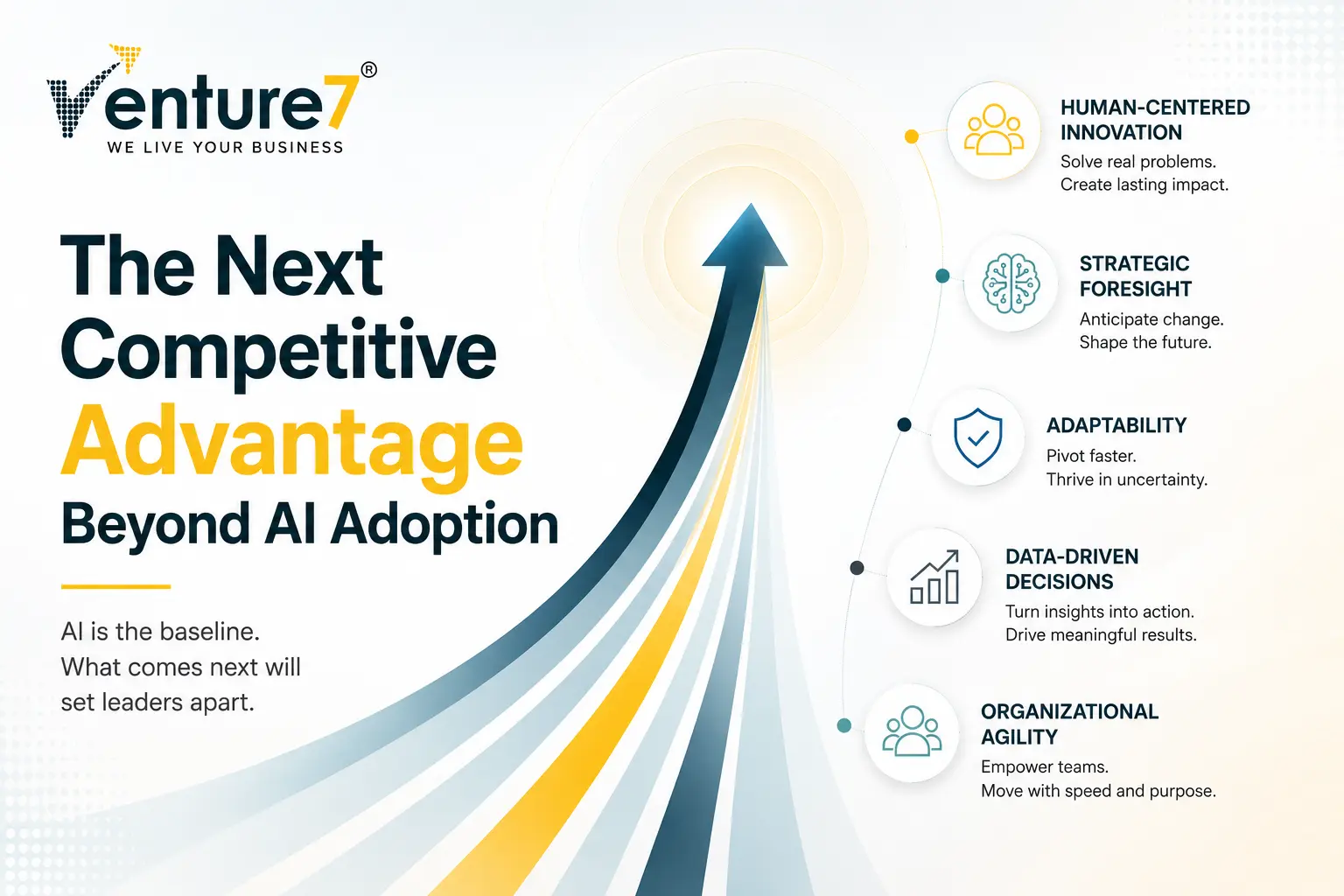
The next competitive advantage after AI adoption will come from operational intelligence, AI-native infrastructure, workflow orchestration, and enterprise-wide execution maturity. As artificial intelligence becomes increasingly accessible across industries, organizations that operationalize AI effectively across systems, workflows, and decision-making environments will outperform businesses focused only on AI implementation.
Artificial intelligence has rapidly evolved from an emerging technology initiative into a foundational component of enterprise transformation. Organizations across healthcare, finance, SaaS, manufacturing, logistics, and enterprise technology are investing heavily in AI systems to improve operational efficiency, automate workflows, modernize customer engagement, and accelerate decision-making. However, enterprise AI adoption is entering a new phase.
AI platforms, copilots, workflow automation systems, and large language models are now widely available through cloud ecosystems and enterprise software providers. Technologies that once created strong competitive differentiation are becoming increasingly standardized across industries. This shift is fundamentally changing how enterprises compete.
Organizations generating long-term enterprise value are no longer differentiated simply by AI adoption. They are differentiated by how effectively they integrate intelligence into enterprise operations, workflows, infrastructure systems, analytics environments, and business execution processes.
The next generation of enterprise leaders will be organizations capable of building intelligent operational ecosystems that combine:
- AI-driven automation
- Predictive operational analytics
- Workflow intelligence
- Enterprise orchestration
- AI-native infrastructure
- Scalable decision systems
The enterprise conversation is moving beyond AI adoption and toward operational AI maturity.
Why AI Adoption Alone Is No Longer Enough
Enterprise AI adoption accelerated rapidly as organizations implemented generative AI platforms, predictive analytics systems, workflow automation tools, and AI-powered enterprise applications to modernize operations and improve business performance.
In the early stages of AI transformation, organizations gained significant advantage simply by implementing AI systems because enterprise AI expertise was limited, infrastructure complexity created deployment barriers, implementation costs were high, and AI ecosystems were still emerging. That environment has changed dramatically.
Enterprise AI technologies are now widely accessible through cloud-based AI ecosystems, enterprise SaaS platforms, API-driven AI services, AI copilots, automation frameworks, and low-code AI environments. As access to AI expands, AI itself is becoming increasingly commoditized.
Organizations across industries can now deploy similar AI capabilities using standardized platforms and enterprise software ecosystems. This means competitive differentiation can no longer come from AI access alone. The next enterprise advantage is shifting toward operational execution and enterprise intelligence.
Why Enterprises Are Struggling After AI Adoption
Many organizations implemented AI systems without redesigning workflows, modernizing operational infrastructure, or establishing enterprise-wide orchestration strategies. As a result, AI environments often remain fragmented and disconnected from core business operations.
Common enterprise AI adoption challenges include:
- Isolated AI pilots that never scale
- Fragmented automation systems across departments
- Weak integration between AI systems and enterprise workflows
- Poor enterprise data coordination
- Limited operational visibility
- Lack of governance and orchestration frameworks
- Tool-first implementation strategies without business alignment
These limitations reduce enterprise scalability and prevent organizations from generating measurable long-term value from AI investments. Many enterprises are discovering that AI deployment alone does not automatically improve operational performance. Sustainable enterprise value comes from operational integration and execution maturity.
The Competitive Landscape Is Shifting Toward Operational Intelligence
The next phase of enterprise competition is increasingly defined by operational intelligence systems capable of coordinating workflows, analyzing enterprise data continuously, improving execution dynamically, and optimizing business performance in real time.
Traditional enterprises often operate through disconnected systems, siloed operational workflows, reactive decision-making, fragmented analytics environments, and manual process coordination. These operational limitations reduce scalability and slow enterprise responsiveness.
AI-native enterprises operate differently. They build connected operational ecosystems capable of intelligent workflow orchestration, predictive operational analytics, adaptive process coordination, real-time operational visibility, and autonomous execution optimization.
This shift allows enterprises to move beyond static automation and toward continuously improving operational environments. Organizations capable of integrating operational intelligence into enterprise execution systems will create stronger scalability, adaptability, and long-term resilience than competitors relying on fragmented AI deployments.
What Defines the Next Competitive Advantage in the AI Era
The next competitive advantage is being created by organizations capable of operationalizing intelligence across enterprise systems, operational workflows, infrastructure environments, and decision-making architectures.
This transformation includes several critical enterprise capabilities that improve operational scalability, execution quality, and business responsiveness.
AI-Native Operational Infrastructure
AI-native infrastructure enables enterprises to integrate intelligence directly into workflows, analytics environments, and operational systems rather than treating AI as an isolated technology layer. These environments support predictive operational analytics, adaptive workflow coordination, intelligent execution systems, enterprise orchestration, and scalable AI deployment.
Traditional enterprise systems were designed for static operational workflows and manual coordination. These environments often struggle to support scalable AI operations effectively because they lack interoperability, operational visibility, and intelligent coordination capabilities.
AI-native infrastructure improves:
- Enterprise scalability
- Workflow coordination
- Operational responsiveness
- Execution speed
- Operational visibility
Organizations with mature AI-native infrastructure environments can reduce workflow bottlenecks, improve execution efficiency, optimize operational coordination, and respond faster to changing business conditions.
Intelligent Workflow Orchestration
Traditional automation systems focused primarily on repetitive task execution using predefined workflows. Modern enterprise environments require significantly more adaptive operational systems capable of responding dynamically to changing business conditions.
Intelligent workflow orchestration combines AI systems, workflow automation, predictive analytics, operational intelligence, and enterprise coordination systems to create connected execution environments capable of improving continuously.
Enterprise workflows increasingly span multiple departments, distributed operational systems, cloud environments, customer engagement platforms, and analytics ecosystems. Disconnected workflows reduce operational efficiency and create execution delays across the organization.
Workflow intelligence enables:
- Adaptive process coordination
- Predictive workflow optimization
- Intelligent task routing
- Real-time operational visibility
- Cross-functional workflow alignment
Organizations implementing intelligent orchestration systems improve operational consistency, execution speed, enterprise coordination, and process scalability significantly compared to enterprises relying on fragmented automation systems.
Enterprise Operational Intelligence
Operational intelligence systems allow enterprises to analyze operational conditions continuously and improve decision-making in real time. These systems combine enterprise analytics, AI-driven insights, workflow intelligence, and predictive analytics to support adaptive operational execution.
Traditional decision-making environments often rely on delayed reporting systems and fragmented analytics processes. This creates operational blind spots that reduce enterprise responsiveness and increase execution inefficiencies.
Operational intelligence systems improve:
- Real-time enterprise visibility
- Predictive decision-making
- Workflow optimization
- Operational forecasting
- Execution coordination
Organizations capable of embedding intelligence directly into operational systems can identify risks earlier, optimize workflows faster, and improve enterprise responsiveness continuously.
AI-Native Enterprises Will Outperform Traditional Organizations
AI-native enterprises represent a fundamental shift in enterprise architecture and operational design. Unlike traditional organizations where AI is implemented as a standalone productivity layer, AI-native enterprises integrate intelligence directly into workflows, enterprise systems, analytics environments, and operational processes.
This allows intelligence to become part of the operational foundation of the business rather than an isolated technology capability.
AI-native organizations are designed around:
- Connected intelligence systems
- Adaptive workflows
- Intelligent orchestration
- Predictive operational analytics
- Autonomous coordination systems
Traditional enterprises often struggle with disconnected operational systems, fragmented workflows, siloed data environments, and slow decision-making processes. AI-native operational models reduce these limitations by creating continuously improving execution environments.
Strategic advantages of AI-native enterprises include:
- Faster enterprise execution
- Improved operational efficiency
- Greater workflow scalability
- Better enterprise adaptability
- Enhanced customer responsiveness
- Reduced operational friction
Operational agility is becoming one of the most important drivers of long-term enterprise competitiveness.
Business Benefits of Building Competitive Advantage Beyond AI Adoption
Organizations that move beyond isolated AI adoption and focus on operational intelligence, workflow orchestration, and AI-native enterprise systems gain measurable long-term business advantages. As enterprise AI technologies become increasingly standardized, competitive differentiation is shifting toward execution maturity, operational scalability, and intelligent enterprise coordination.
Improved Operational Efficiency Across Enterprise Workflows
AI-native operational systems help enterprises reduce operational friction by integrating intelligence directly into workflows and execution environments. Instead of relying on disconnected systems and manual coordination, organizations can automate decision flows, optimize task routing, and improve operational consistency across departments.
Operational efficiency benefits include:
- Reduced workflow bottlenecks
- Faster task execution across departments
- Lower manual coordination requirements
- Improved process consistency
- Better utilization of enterprise resources
- Reduced operational redundancies
Organizations with intelligent operational systems can execute business processes more efficiently while improving scalability across enterprise environments.
Faster Enterprise Decision-Making Through Operational Intelligence
Modern enterprises operate in increasingly data-intensive and rapidly changing environments where delayed decision-making creates operational risk. AI-driven operational intelligence systems improve enterprise responsiveness by providing real-time analytics, predictive insights, and intelligent recommendations directly within operational workflows.
Enterprise decision intelligence advantages include:
- Real-time operational visibility
- Faster strategic decision-making
- Improved forecasting accuracy
- Predictive operational analytics
- Better enterprise responsiveness
- Reduced delays in business execution
Organizations capable of combining predictive intelligence with operational workflows improve business agility significantly compared to enterprises operating through reactive decision environments.
Greater Enterprise Scalability and Operational Flexibility
Traditional operational systems often struggle to scale efficiently because workflows depend heavily on manual coordination, fragmented systems, and disconnected enterprise processes. AI-native operational environments improve scalability by enabling intelligent workflow coordination and adaptive operational execution.
Scalability advantages include:
- Intelligent workflow coordination
- Adaptive operational systems
- Improved enterprise responsiveness
- Faster operational expansion
- Reduced infrastructure limitations
- Better cross-functional coordination
Operational flexibility is becoming one of the most important enterprise capabilities as organizations face rapidly changing customer expectations, market conditions, and operational demands.
Stronger Customer Experience and Service Responsiveness
Organizations that operationalize AI effectively across customer-facing systems can significantly improve customer experience quality, service responsiveness, and operational consistency. AI-driven enterprise systems enable businesses to analyze customer behavior, predict requirements, automate engagement processes, and improve service coordination.
Customer experience improvements include:
- Faster customer support resolution
- Improved personalization capabilities
- Better service coordination
- Predictive customer engagement
- Reduced response delays
- Enhanced customer satisfaction
As customer expectations continue to increase, enterprises capable of delivering intelligent and adaptive experiences gain stronger long-term market positioning.
Enterprise Infrastructure Is Becoming the New Competitive Layer
As AI adoption matures, infrastructure is becoming more important than AI models themselves. Organizations that fail to modernize infrastructure environments often struggle with fragmented AI systems, scalability limitations, integration bottlenecks, and governance complexity.
Modern enterprise AI environments require infrastructure capable of supporting:
- Real-time operational intelligence
- Predictive analytics systems
- Workflow orchestration
- Enterprise-wide AI deployment
- Cross-functional data coordination
Core Components of AI-Native Infrastructure
Enterprise Data Architecture
Supports scalable AI systems and real-time operational intelligence environments.
Workflow Orchestration Layers
Coordinate enterprise workflows across systems, departments, and operational processes.
Predictive Analytics Systems
Enable proactive decision-making and operational optimization.
Governance and Observability Frameworks
Improve compliance, transparency, operational oversight, and enterprise scalability.
Scalable Cloud and AI Environments
Support continuous operational growth and enterprise adaptability.
Organizations with mature infrastructure environments can scale AI operations significantly more effectively than businesses operating on fragmented legacy systems.
Why Many Enterprises Will Struggle in the Next Phase of AI Transformation
Although AI adoption continues accelerating, many organizations remain unprepared for the operational complexity associated with large-scale AI transformation.
Common enterprise challenges include:
- Weak governance maturity
- Poor infrastructure scalability
- Disconnected operational systems
- Fragmented AI deployments
- Limited workflow integration
- Unclear operational ownership
- Inconsistent enterprise data coordination
As enterprise AI ecosystems become more advanced, these operational limitations create major scalability and execution risks. Organizations that fail to modernize workflows, infrastructure systems, and operational coordination environments may struggle to generate measurable long-term value from AI investments. The next phase of enterprise transformation will require significantly greater operational maturity than the initial AI adoption phase.
The Future of Enterprise Competition After AI Adoption
Enterprise competition is shifting toward intelligent operational ecosystems capable of coordinating workflows, analyzing enterprise data continuously, improving execution dynamically, and adapting rapidly to changing business conditions.
Future enterprise leaders will be organizations capable of building:
- AI-native operational systems
- Intelligent workflow environments
- Predictive operational intelligence ecosystems
- Adaptive enterprise coordination systems
- Autonomous process optimization frameworks
This transformation represents a major shift away from isolated AI experimentation and toward enterprise-wide intelligence orchestration.
Operational execution quality, infrastructure maturity, workflow intelligence, and enterprise adaptability will define the next generation of market-leading organizations.
Enterprises that successfully operationalize AI across operational systems, infrastructure environments, and workflow ecosystems will create stronger scalability, efficiency, responsiveness, and long-term resilience than competitors focused solely on AI adoption.
The future competitive advantage after AI adoption will not belong to organizations with the largest number of AI tools. It will belong to enterprises capable of building intelligent operational ecosystems that continuously improve how the business executes, adapts, and scales.
How Venture7 Helps Organizations Build AI-Native Enterprise Systems
Venture7® helps organizations move beyond isolated AI implementation and build intelligent enterprise ecosystems designed for scalable business transformation.
The focus is not simply on deploying automation tools. Venture7® partners with enterprises to design AI-native operational systems that integrate workflow intelligence, predictive analytics, enterprise data architecture, governance frameworks, and scalable AI infrastructure into connected business environments.