
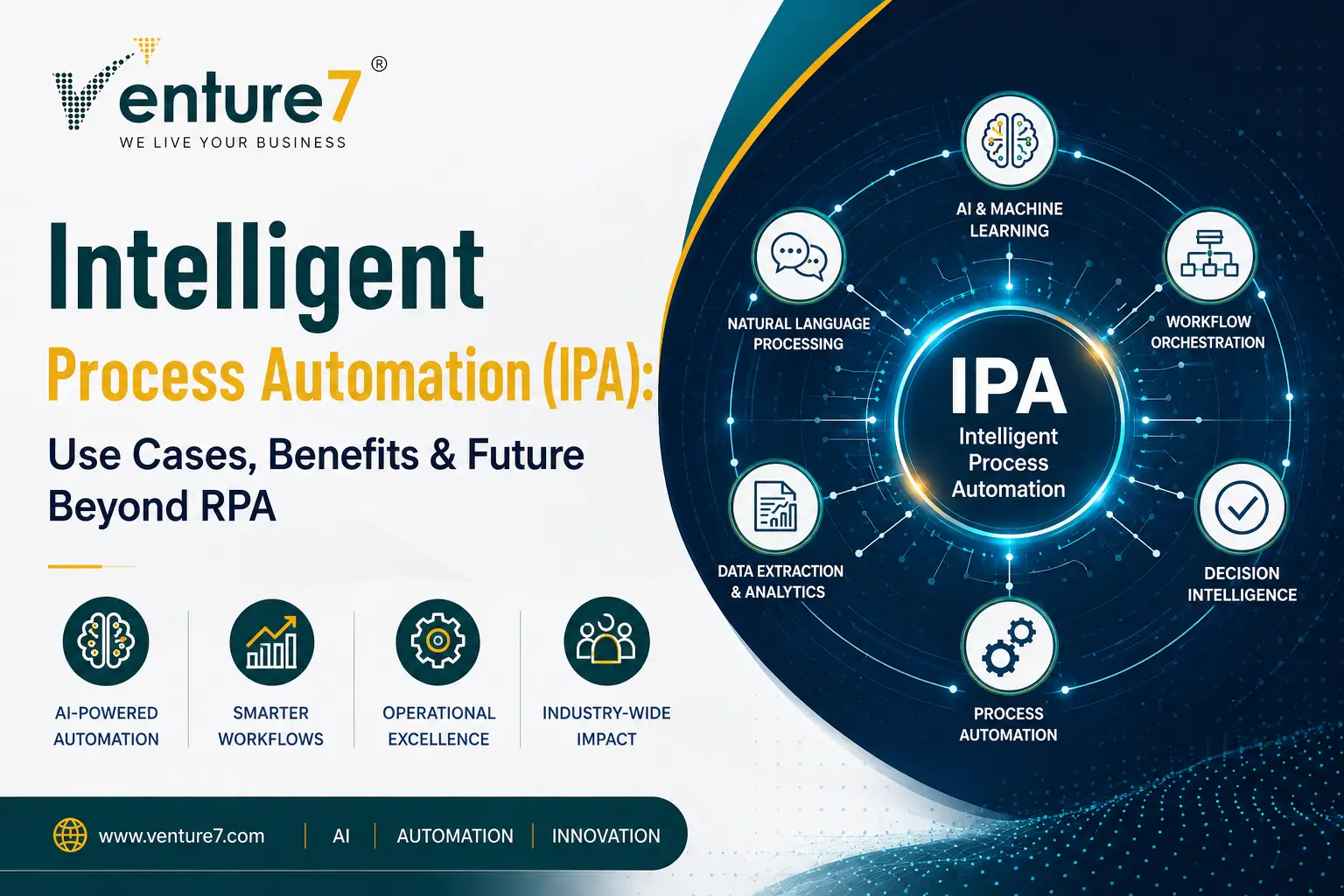
Intelligent Process Automation (IPA) is an AI-driven automation approach that combines machine learning, natural language processing, and workflow automation to streamline business processes, improve decision-making, and reduce operational costs.
Intelligent Process Automation (IPA)
Intelligent Process Automation (IPA) is an advanced form of AI-driven automation that enables businesses to streamline workflows, reduce operational costs, and improve decision-making by combining artificial intelligence, machine learning, and workflow orchestration. Unlike traditional Robotic Process Automation (RPA), which relies on predefined rules, IPA introduces adaptability and intelligence into workflows, allowing systems to respond dynamically to real-world conditions.
This approach allows organizations to move beyond simple task automation and focus on optimizing entire business processes. By integrating intelligence into workflows, IPA improves consistency, reduces manual intervention, and enhances operational efficiency across departments. It is particularly valuable in environments where processes involve high data volumes, variability, and decision complexity.
In practical terms, Intelligent Process Automation enables systems to interpret structured and unstructured data, identify patterns, make context-aware decisions, and continuously improve through learning. This transforms automation from a static execution layer into a strategic capability that supports long-term scalability and performance.
Why Intelligent Process Automation Matters for Modern Businesses
Intelligent Process Automation has become a critical capability for organizations operating in data-driven and highly competitive environments. Traditional automation tools are no longer sufficient to manage the complexity of modern workflows, which require adaptability, real-time decision-making, and cross-system coordination.
Organizations adopting IPA are able to reduce operational inefficiencies, improve accuracy, and respond more effectively to changing business conditions. The ability to automate decision-making processes, rather than just repetitive tasks, allows companies to operate with greater speed and consistency.
In addition, IPA supports scalability by enabling businesses to handle increased workloads without a proportional increase in resources. This makes it a key driver of operational transformation, especially for enterprises looking to optimize performance while controlling costs.
How Intelligent Process Automation Works in Practice
Intelligent Process Automation works by combining multiple technologies into a unified system that can execute tasks, analyze data, and make decisions across workflows. Instead of relying on a single automation tool, IPA integrates various capabilities that work together to improve efficiency and adaptability.
Machine learning enables systems to analyze historical data, identify patterns, and improve performance over time. Natural language processing allows systems to understand and process human language, making it possible to automate tasks involving emails, documents, and conversations. Decision intelligence provides the ability to evaluate context and determine the most appropriate action, while workflow orchestration ensures that processes are connected and executed seamlessly across systems.
This combination of technologies enables organizations to build automation systems that are not only efficient but also adaptive and scalable, capable of handling complex and evolving business requirements.
Why Businesses Are Moving Beyond RPA
While Robotic Process Automation has delivered value in automating repetitive and rule-based tasks, it is increasingly limited in its ability to handle complex and dynamic workflows. As business environments become more data-driven and interconnected, the need for more advanced automation capabilities has become evident.
RPA systems depend heavily on structured data and predefined rules, which makes them fragile in environments where processes change frequently. Even minor updates to systems or workflows can disrupt automation, leading to increased maintenance efforts and reduced efficiency.
In addition, RPA focuses on individual tasks rather than entire processes, resulting in fragmented automation and limited scalability. Intelligent Process Automation addresses these limitations by introducing learning, adaptability, and end-to-end process optimization, making it a more suitable solution for modern enterprises.
Industry-Specific AI Use Cases
AI for Healthcare
Healthcare organizations are increasingly adopting Intelligent Process Automation to improve patient outcomes, reduce administrative burden, and enhance operational efficiency. The complexity of healthcare workflows, combined with the need for accuracy and compliance, makes AI-driven automation particularly valuable in this sector.
IPA enables healthcare providers to streamline processes such as patient intake, clinical documentation, and billing, reducing manual effort and minimizing errors. It also supports better care coordination by ensuring that patient data is accessible and actionable across systems. Additionally, predictive analytics and remote monitoring capabilities allow providers to deliver more proactive and personalized care.
Key Use Cases
- Clinical documentation automation to reduce manual data entry
- Patient intake and registration for faster onboarding
- Claims and billing automation to improve accuracy
- Care coordination workflows across departments
- Remote patient monitoring for continuous care
- Appointment and referral automation
- Healthcare analytics and reporting
AI for Senior Care
Senior care organizations require efficient and scalable systems to manage patient care and operational workflows. Intelligent Process Automation helps these organizations improve service delivery while reducing administrative complexity.
By automating documentation, billing, and coordination processes, IPA allows caregivers to focus more on patient care. It also enables better monitoring of patient health through real-time data analysis, improving outcomes and reducing risks.
Key Use Cases
- Clinical documentation automation
- Patient intake and registration
- Claims and billing automation
- Care coordination workflows
- Remote patient monitoring
- Appointment and referral management
- Analytics and reporting
AI for Business Processes
Organizations across industries are leveraging Intelligent Process Automation to optimize internal operations and improve efficiency. By automating repetitive and data-intensive tasks, businesses can reduce manual effort and improve consistency.
IPA enables end-to-end workflow orchestration, allowing processes to operate seamlessly across departments. It also improves decision-making by providing real-time insights and enabling automated approvals.
Key Use Cases
- Process automation for repetitive tasks
- Workflow orchestration across systems
- Document processing and OCR
- Approval and decision automation
- Data extraction and validation
- Compliance monitoring
- Operational performance analytics
AI for Salesforce
Sales organizations are using Intelligent Process Automation to improve lead management, forecasting accuracy, and customer insights. By leveraging AI-driven analytics, teams can make more informed decisions and optimize sales processes.
IPA enables automation of repetitive tasks such as data entry and follow-ups, allowing sales teams to focus on high-value activities. It also improves pipeline visibility and helps identify opportunities for growth.
Key Use Cases
- Lead scoring and prioritization
- Sales forecasting
- Customer segmentation and insights
- Workflow automation
- AI-powered service chatbots
- Predictive opportunity management
- Data cleansing and enrichment
AI for HR & Recruitment
Human resource teams are adopting Intelligent Process Automation to improve hiring efficiency and workforce management. By automating tasks such as resume screening and candidate matching, organizations can reduce time-to-hire and improve hiring quality.
IPA also supports workforce planning and employee retention by providing predictive insights and performance analytics. This enables HR teams to make more strategic decisions and improve overall organizational performance.
Key Use Cases
- Resume screening and candidate filtering
- Candidate matching
- Employee attrition prediction
- Workforce planning
- Performance analytics
- HR process automation
- Learning personalization
AI for Compliance & Risk
Organizations use Intelligent Process Automation to manage compliance requirements and reduce risk. By automating monitoring and reporting processes, businesses can ensure adherence to regulations and improve governance.
IPA enables real-time risk detection and supports proactive decision-making, reducing the likelihood of compliance issues and financial losses.
Key Use Cases
- Regulatory monitoring
- Policy violation detection
- Audit automation
- Risk scoring
- Reporting automation
- Governance analytics
- Fraud prevention
AI for SaaS & Enterprise
SaaS and enterprise companies use Intelligent Process Automation to improve product performance, customer retention, and operational efficiency. By analyzing user behavior and system data, organizations can gain insights that drive growth and innovation.
IPA supports workflow automation, predictive analytics, and reporting, enabling businesses to scale effectively and respond to changing market conditions.
Key Use Cases
- Process automation
- Customer analytics and insights
- Predictive churn analysis
- Product usage analytics
- Workflow orchestration
- AI copilots for teams
- Enterprise reporting and forecasting
AI for EdTech
EdTech platforms are using Intelligent Process Automation to personalize learning experiences and improve educational outcomes. By analyzing student data, systems can provide tailored recommendations and identify areas for improvement.
IPA also enables automation of administrative tasks, allowing educators to focus more on teaching and student engagement.
Key Use Cases
- Personalized learning
- Student performance prediction
- Automated grading
- Virtual tutors
- Dropout risk analysis
- Curriculum optimization
- Learning analytics
AI for Logistics & Supply Chain
Logistics and supply chain operations benefit from Intelligent Process Automation by improving efficiency, visibility, and decision-making. AI-driven systems can optimize routes, forecast demand, and manage inventory more effectively.
This results in reduced costs, improved delivery times, and better resource utilization across the supply chain.
Key Use Cases
- Demand forecasting
- Inventory optimization
- Route optimization
- Shipment tracking
- Risk detection
- Warehouse automation
- Supply chain analytics
Benefits of Intelligent Process Automation Across Industries
Intelligent Process Automation delivers consistent and measurable benefits across industries by transforming how organizations manage workflows, data, and decision-making. Unlike traditional automation, which focuses on isolated tasks, IPA enables end-to-end process optimization, allowing businesses to operate with greater efficiency, accuracy, and scalability.
By combining artificial intelligence with workflow orchestration, organizations can reduce operational complexity while improving responsiveness to changing business conditions. This is particularly valuable in industries where processes are data-intensive, time-sensitive, and require continuous improvement.
In addition, Intelligent Process Automation supports long-term growth by enabling businesses to scale operations without increasing manual effort. It also improves consistency across workflows, ensuring that outcomes are predictable and aligned with business objectives.
Key Benefits
Increased Operational Efficiency
- Reduces manual effort by automating repetitive and time-consuming tasks
- Accelerates process execution across departments and systems
- Eliminates bottlenecks in workflows through intelligent orchestration
- Improves overall productivity by allowing teams to focus on strategic work
Cost Optimization and Resource Utilization
- Lowers operational costs by reducing dependency on manual processes
- Minimizes errors and rework, leading to cost savings over time
- Optimizes resource allocation by aligning workloads with system capacity
- Reduces overhead associated with process management and supervision
Improved Decision-Making and Accuracy
- Enables real-time data analysis for faster and more informed decisions
- Reduces reliance on intuition by providing data-driven insights
- Improves accuracy by minimizing human error in critical processes
- Supports predictive decision-making using historical and real-time data
Enhanced Scalability and Flexibility
- Allows organizations to scale operations without proportional increases in workforce
- Adapts to changing business requirements and workflow complexity
- Supports expansion across multiple departments and geographies
- Maintains performance consistency even with increased workload
Better Customer and User Experience
- Improves response times through automated and intelligent workflows
- Enables personalized interactions using AI-driven insights
- Reduces delays and errors in customer-facing processes
- Enhances service quality and consistency across touchpoints
Stronger Compliance and Risk Management
- Automates monitoring of regulatory requirements and policy adherence
- Detects anomalies and potential risks in real time
- Improves audit readiness through automated reporting and tracking
- Reduces compliance-related errors and operational risks
Continuous Improvement and Process Optimization
- Learns from data to improve performance over time
- Identifies inefficiencies and suggests process improvements
- Enables continuous monitoring and optimization of workflows
- Supports long-term operational excellence and innovation
How Venture7 Helps Businesses Implement Intelligent Process Automation
Venture7 partners with organizations to design and implement Intelligent Process Automation solutions that go beyond isolated use cases and deliver measurable business outcomes. The focus is on identifying high-impact opportunities across workflows, aligning automation with operational goals, and building systems that improve efficiency, reduce costs, and support scalable growth.
Rather than applying generic automation tools, Venture7 takes a process-first approach—analyzing how work actually flows across systems, where inefficiencies exist, and how AI can introduce intelligence into decision-making. This ensures that automation is not only effective at launch but continues to improve as business conditions evolve.
With expertise across AI, data engineering, and workflow orchestration, Venture7 enables organizations to move from fragmented automation to fully integrated, intelligent systems that drive long-term performance.
What Venture7 Delivers
- End-to-end Intelligent Process Automation strategy and implementation
- Industry-specific AI solutions tailored to operational workflows
- Integration with existing systems and enterprise platforms
- Scalable architectures designed for long-term growth
- Continuous optimization and performance improvement
Book a demo to explore how Venture7 can optimize your operations with AI.